Ancestors and infinity

Visualising what we owe

I learnt something new this year about the day before Diwali/Kali Pujo. Bangalis apparently celebrate it — I say apparently, because (shamefully enough) this was the first time I had heard of it — as Bhoot Chaturdashi. Given the very rough colloquial translation, as “the fourteenth day [of the lunar fortnight], of ghosts,” the occasion feels almost tailor-made for all sorts of funny posts on social media.

But bhoot also means ‘the past’ (just like kaal means time as well as death or distress). As one commentator put it, multiple meanings of the word leave the occasion up to many interpretations. But two observances remain common. On that day, believers honour the spirits of fourteen generations of ancestors by lighting an equal number of lamps in the evening. They also consume a savoury lightly-fried dish made with fourteen (!) specific kinds of greens. In spirit — yes, I couldn’t resist — Bhoot Chaturdashi is more Día de los Muertos, interestingly also celebrated (roughly) around the same time, and less Halloween.

Though who knows what the exact, exhaustive, protocol is for the occasion, if any. Ma excitedly claims you should also keep a (new) broom near the main entrance to your home to chase (presumably less-than-friendly) spirits away. Meanwhile, perennially sceptical Bapi is convinced the fourteen-greens pre-mix sold in his neighbourhood market in Kolkata has five kinds instead, unscrupulously mixed with random leaves to fleece the gullible.

Neither the spouse nor I are big believers in spirits or, for that matter, arbitrary emplacement of cleaning equipment. Nevertheless, the idea of earmarking a day to dead ancestors — even ones we had never met — kind of resonated. We lit the prescribed fourteen lamps in the evening. (I had pedantically advanced, it should have been twenty-eight instead — to cover both sides –, an unpersuasive argument as far as the spouse was concerned.) Meanwhile, the fourteen shaak will have to wait for next year, given the near-impossibility of finding more than half of the greens here, especially on the fly.

In Bangla, whenever you feel the urge to hyperbolically refer to your ancestors — the whole lot — you say choddo purush (fourteen generations). That’s a lot of ancestors, numerically. Even if you only consider your parents (2^1 = 2), grandparents (2^2 = 4), great-grandparents (2^3 = 8) and so on — setting uncles and aunts and variants thereof aside — fourteen generations is almost 33,000 people (32,766, to be precise).

This is very basic arithmetic, how geometric series works. But it is, also, extremely striking. If you think about it.

These 32,766 people — for me, beginning with those who lived in Mughal India — have contributed significantly to who I am today, to my totality. Despite what Steven Pinker has termed as the modern denial of human nature, genes matter. But also equally, and as part of our dual inheritance, it is lived experience and norms that are passed on from parents to their children that shapes, even in — especially in — breach. My mother’s contagious enthusiasm and my father’s probing, inward-looking, outlook, are, in large measure, why I am often carried away by the new, even as a part of me worries about what that may entail.

A picture helps us visualise the web of what we may owe our ancestors, if nothing as an aid in reflection.

Here’s one I whipped up using Python’s networkx library, with a defined layout that puts generations in concentric circles. (Evolutionary trees are sometimes depicted in roughly similar fashion.) Male parents are blue nodes; female pink. Any given node (child) in the network will be connected to one male and one female node (parents) through edges (light blue). The green node in the centre is you. Node sizes become smaller as we go back in time.

Let’s start with nine generations.
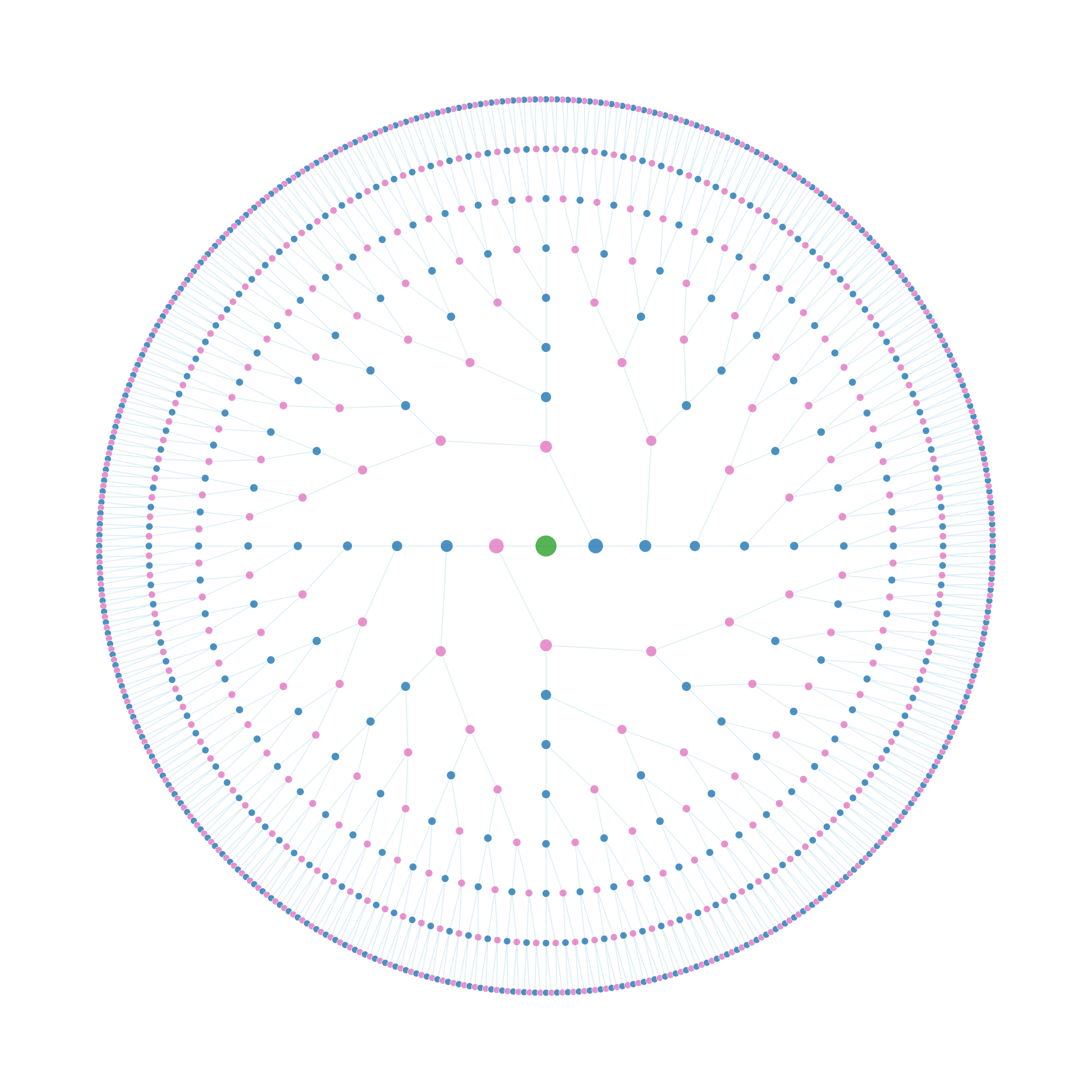
Nine generations. Total number of ancestors: 1,022.

And, here’s fourteen generations, your choddo purush (albeit defined narrowly).

Fourteen generations. Total number of ancestors: 32,766. The greyish and light-bluish outer bands are edges connecting parents and children bunched together. The whitish bands are male and female nodes squeezed in side-by-side. Note the exponential increase in number of ancestors: the 14th generation has 2^14 = 16,384 ancestors, just two more than the sum of all ancestors in 13 generations before.

For reasons that are not completely clear to me, this reminds me of Dutch artist M.C. Escher’s “circle limit” series of woodcuts. The vagueness of the resemblance is irritating, more so given that while Escher drew significantly from hyperbolic geometry — aided by the great geometer H.S.M. Coxeter — ours is an extremely simple representation, a plain network created by a simple rule, laid out in a specific way.
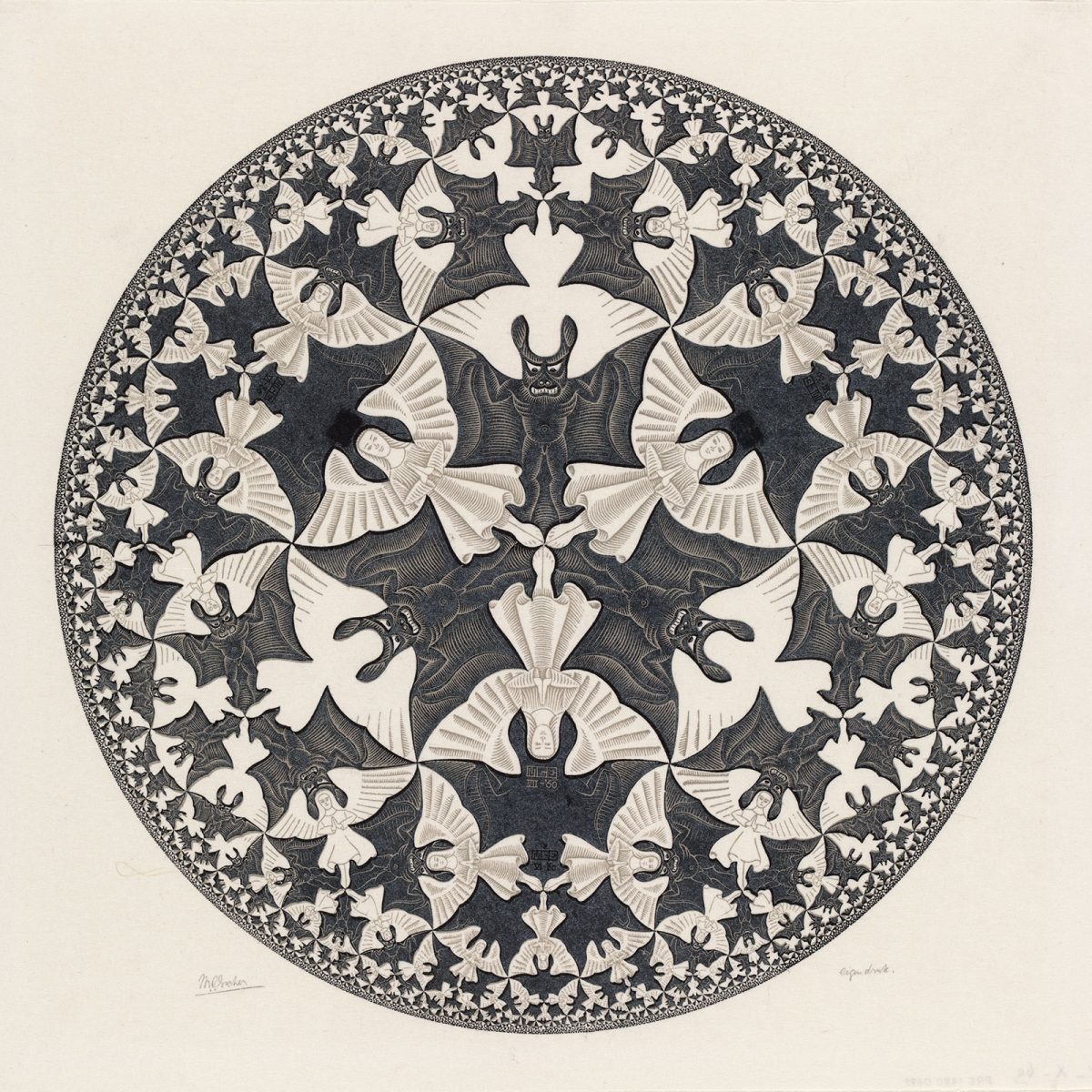
M.C. Escher, Circle Limit IV (Heaven and Hell), 1960. Image: website of Museum Escher in Het Paleis, The Hague, https://escherinhetpaleis.nl/en/about-escher/escher-today/circle-limit-iv-heaven-and-hell.

Escher’s woodcut is about good and evil complimenting each other, stretching all the way to infinity, angels and devils becoming smaller and smaller as we reach for the boundary of the Poincaré disk.

So, perhaps the reason why I sense a similarity is because the simple genealogical tree and Escher’s woodcuts both depict the innumerable and distant radiating inward, complimenting each other, amplified in appearance — and in appearance alone?

But the centre is illusory in Escher, inconsequential, existing solely to visually enforce a sense of symmetry. Having admitted the conceptual congruence, should we, therefore, not consider the centre in our ancestral network — us — similarly?
Games as metaphors: The case for Snakes and Ladders

Some thoughts on a game of chance

It is not a spectacularly original observation that games serve as metaphors for dimly-illuminated things and processes — things and processes we wish we understood better and could therefore exert greater control over, which is to say, all human existence.

Strategic affairs commentators speak of country X playing chess while Y (more often than not, their own) playing checkers, country bumpkins the whole lot of the blob being the unstated point they wish to make.

The more pretentious of the lot reverentially speak of China playing weiqi, juxtaposing the wisdom of the Chairman and the Party with Sun Tzu, with references to the strategic wisdom of Uncle Ho and Giap thrown in for good measure. How can the analyses of the straight and narrow children of the Enlightenment measure up to such subtle thinking of the Asian giants, they seem to suggest.

More honest and deeper minds — having shed affect for effect — too discern that games and associated rituals often clarify what we deeply suspect to be true but could never quite articulate ourselves:

Madame Sosostris, famous clairvoyante,
Had a bad cold, nevertheless
Is known to be the wisest woman in Europe,
With a wicked pack of cards. Here, said she,
Is your card, the drowned Phoenician Sailor,
(Those are pearls that were his eyes. Look!)
Here is Belladonna, the Lady of the Rocks,
The lady of situations.
Here is the man with three staves, and here the Wheel,
And here is the one-eyed merchant, and this card,
Which is blank, is something he carries on his back,
Which I am forbidden to see. I do not find
The Hanged Man. Fear death by water.
-- T.S. Eliot, The Waste Land

Games have preoccupied me too, as a former member of the “strategic community” and more generally, as an intellectually itinerant student of human behavior. But it is only now — as I am forced to confront the vagaries of my own life from the disconcerting vantage of middle age and all that it engenders — that I sense a sudden urgency in mapping what I understand to be true of social life onto boards, hex maps, game pieces, dice, and much more frequently, computer code. And I fear, I dread, that far more than games of strategy, it is the games of pure chance that may serve as better guides for me.

Luck is all the things we don’t see that conspire to force an outcome, the sizeable error term as we regress what actually happened on all the things that we could control (or at least imagined we could). Ergo, to understand the unseen, the violently capricious forces that so often threaten to overwhelm individuals, societies, or nations, simulate through game play — on printed cardboard or silicon chips, or simply in your mind on a listless gloomy day.

On more than one occasion, I tell myself: Eschew decision trees, the Bayesian world of priors and posteriors, of non-parametric statistics and machine learning tool kits. At the very least, I urge myself: Add more chance and not less in models of lives, your own and others’, and only through this little trick, only through this sole instrument, can you faithfully render intelligibility to an otherwise incomprehensible world.

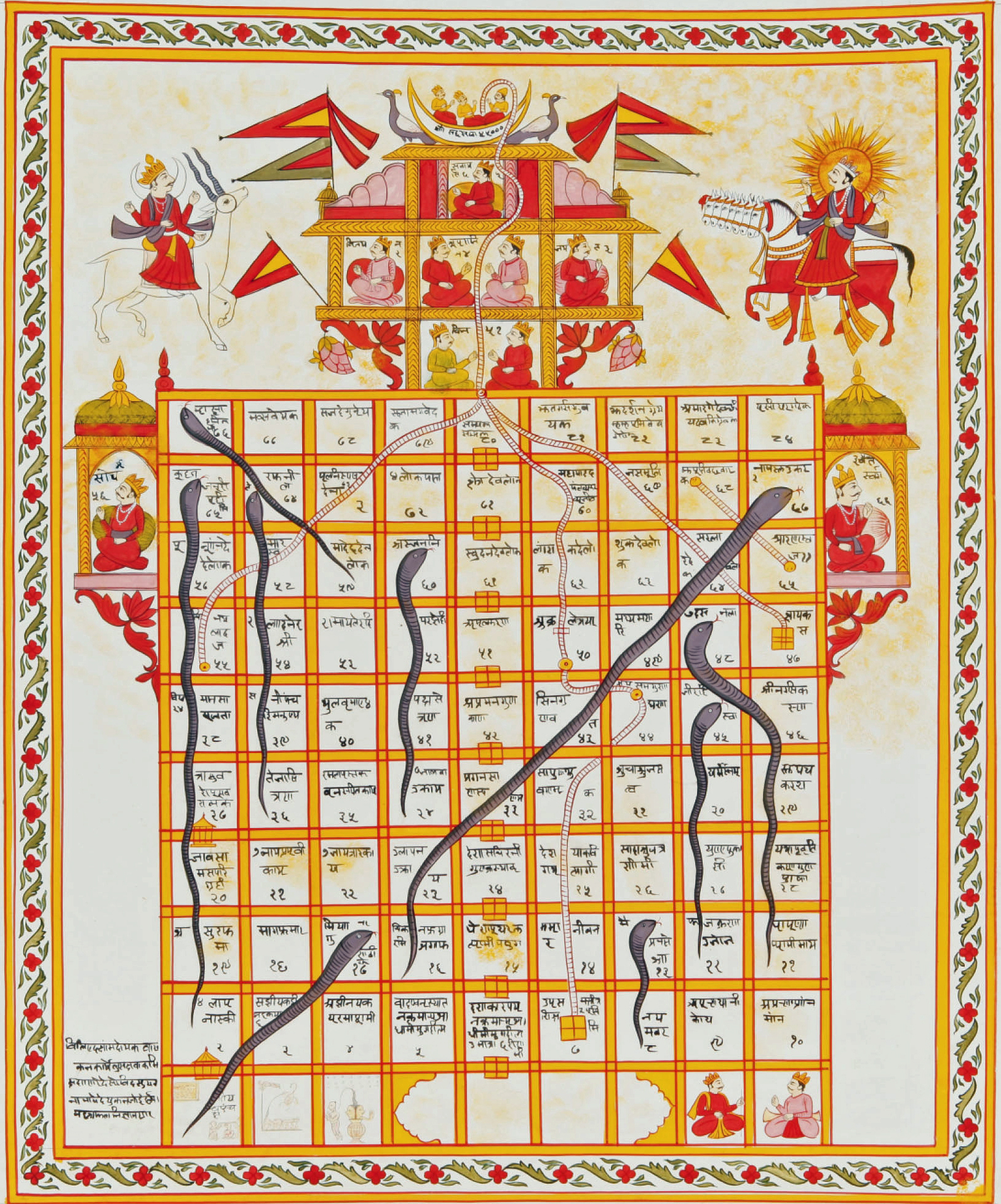
Consider the humble Snakes and Ladders. Is it not a faithful replica of how life looks, of lives where we were undeserving of both the buoyant lifts of ladders which powered our ambitions, both base and otherwise, and the terrifying descent through bellies of snakes ending in throes of despair? And if it is, what of the incredible pointlessness of it all? Is it not a game a madman shunned by the world plays with God, as the contemporary Bengali troubadour Suman Chattopadhay so memorably sang many decades ago?

Jain version of Snakes and Ladders, India, 19th century, Gouache on cloth. By Jain Miniature – http://www.herenow4u.net/index.php?id=72923, Public Domain, https://commons.wikimedia.org/w/index.php?curid=11471979

Worry not– that seems to be the overarching message of the game as its Indian inventors understood centuries ago, channeling Lord Krishna’s messages on the primacy of action and not outcomes in the Bhagavad Gita. To understand the game, step out of it, look in and look out. Always, always, remember the context in which your actions are situated — in inaction that must be consistently negated — and that which will determine the outcome — your nature and duty, and my wisdom and all-encompassing responsibility, Krishna tells Arjun.

To some this worldview is grimly mechanical and agency-reducing. To me, as I suspect it was to the inventors of Moksha Patam, the point is to keep rolling the die at each turn (dharma, the imperative of the individual), the outcome — either lift or descent or simply trudging along — the result of a trillion different factors which bundled together is perceived by us, in our finitude, as noise or luck.

॥ कर्मण्येवाधिकारस्ते मा फलेषु कदाचन ।
मा कर्मफलहेतुर्भुर्मा ते सङ्गोऽस्त्वाकर्मणि॥
-- Bhagavad Gita, chapter 2, verse 47

which has been translated by Juan Mascaró as:

Set thy heart upon thy work, but never on its reward. Work not for a reward; but never cease to do thy work.

Mathematically, Snakes and Ladders can be modeled as Markov Chains (more precisely, as absorbing Markov Chains). In plain English, it means where you’d land up on the board next in the game depends only on where you are now and not where you have been. This “memorylessness” is unsettling: no matter what your trajectory has been thus far — the accrued weight of your actions — your future is bereft of past and only hinges on the present.

But this is where the message of the game also becomes extremely liberating and hopeful (and why so many children, in particular, are so fond of the game). As long as you negate inaction — as long as you roll the die at your turn — your future is open-ended, a thousand past victories or defeats rendered immaterial. The game often makes you retrace your steps after a near-fatal blow only for you to discover at the very end — as you are absorbed at the 100th square — that that wasn’t so bad after all. Or you never make it, and the other guy does. That’s fine too, you did your best, you played fair.

You learn not to worry. You are here today. You do your duty: you roll the die, indifferent in peace with your self.

On the utility of SETI

From Paul Davies’s “The Eerie Silence: Searching for Ourselves in the Universe”:

The knowledge that an alien community had endured for eons and overcome the multiple problems that mankind currently faces would rekindle human Utopian dreams and become a strong unifying force on our planet. To glimpse a trajectory of human progress mirrored in the stars would have a galvanizing effect far greater than any political rhetoric. In our present state of ignorance it is possible to believe either account of the future: pessimistic or optimistic. But to know we are not the only sentient beings in a mysterious and sometimes frightening universe would provide a dramatic message of hope for mankind.

On the utility of pure mathematics

From Eugenia Cheng’s “The Joy of Abstraction,” arguably the finest general-audience math book written in the recent past:

Subtlety and nuance are aspects of thinking that I find myself missing and longing for in daily life. So much of our discourse has become black-and-white in futile attempts to be decisive, or to grab attention, or to make devastating arguments, or to shout down the opposition. Higher-dimensional category theory trains us in balancing nuance with rigor so that we don’t need to resort to black-and-white, and so that we don’t want to either.

I think mathematics is a spectacular controlled environment in which to practice this kind of thinking. The aim is that even if the theory is not directly applicable in the rest of our lives, the thinking becomes second nature. This is how I have found category theory to help me in everyday life, surprising though it may sound.

On the utility of applied mathematics

From one of my favorite novels, which has the great Soviet mathematician and economics Nobelist Leonid Kantorovich as one of the lead characters.

It was a pleasure to put the lucid order in his [Kantorovich’s] head to use. More than a pleasure, a relief almost, because every time the pure pattern of mathematics turned out to have a purchase on the way the world worked, turned out to provide the secret thread controlling something loud and various and apparently arbitrary, it provided one more quantum of confirmation for what Leonid Vitalevich wanted to believe, needed to believe, did believe when he was happy: that all of this, this swirl of phenomena lurching on through time, this mess of interlocked systems, some filigree-fine, some huge and simple, this tram full of strangers and smoky air, this city of Peter built on human bones, all ultimately made sense, were all intricately generated by some intelligible principle or set of principles working themselves out on many levels at once, even if the expressions didn’t exist yet which could capture much of the process.

Francis Spufford, “Red Plenty”

Methodology note for India-US defence trade article

Refers to: Dalliance No More: How India-US Defence Trade Relationship Matures over Years (News18, February 24, 2020).

General/Data Sources

  1. Foreign Military Sales (FMS) data taken from the US Defense Security Cooperation Agency’s (DSCA) “Foreign Military Sales, Foreign Military Construction Sales and Military Assistance Facts” reports. The latest publicly-available edition is that of 2017. For 2003-2009 data, I have used the 2009 report. For 2010-2017 data, I have used the 2017 report. Note that across individual yearly reports, certain data entries may have minor discrepancies; I have resolved this issue by using two reports (2009 and 2017) dividing the 15-year time period (2003-2017) into two non-overlapping bins.
  2. Direct Commercial Sales (DCS) data taken for the US State Department’s Section 655 Reports to the US Congress. I have used 16 individual year reports to collate the 2003-2018 data set. Note that DCS shipment data for 2009 is missing. I have “filled” this missing entry by replacing it with the median of the 2008-2018 data. The SIPRI database of Section 655 Reports do not have country data for 2011 which was obtained from the Federation of American Scientists.
  3. Indian military modernisation data is from successive Union Budget Revised Expenditure numbers. For definitions used, see an earlier methodology note.

Specific Comments for Figures

  1. Foreign Military Sales Agreements, 2003 – 2017: tabulation of FMS Agreements between 2003 and 2017 with data from 2009 and 2017 reports (see no. 1 above).
  2. Comparison of Foreign Military Sales, 1950-1999 and 2000-2005: Historical data for 1950-1999 taken from the 2009 DSCA report. (In 2000 and 2001, there were no FMS agreements between India and the US on account of sanctions from the 1998 nuclear tests).
  3. Direct Commercial Sales Authorized, Including Agreements (million USD): do note that this includes agreements signed in individual years (reported separately in the Section 655 Reports as Defence Services Authorized till 2013).
  4. Comparison of Agreements & Authorizations with Military Modernisation Budgets, 2006-2014:
    1. ‘Commercial and Government Agreements & Authorizations Total’ is the sum of FMS and DCS for each year between 2006 and 2014.
    2. ‘Foreign Component of Indian Military Modernisation Budgets Total’ was estimated by recording the modernization budgets for each year, and taking a fraction of that using the import content of the modernisation budget. (See points 1 and 2 in page 5 of an earlier methodology note for data sources.) Conversion to USD using each year’s reference exchange (USD/INR) rate, with data from the RBI.
    3. ‘Indian Military Modernisation Budgets Total’ was estimated by summing over the modernisation budgets of each year. (For definition of modernisation budget, see point 1 in page 7 of this note.)
  5. Deliveries and Shipment, 2003-2017: data from State Department Section 655 and DSCA reports. For 2009, the missing DCS shipment data was inferred from other observations (see no. 2 in the previous section).