It is not a spectacularly original observation that games serve as metaphors for dimly-illuminated things and processes — things and processes we wish we understood better and could therefore exert greater control over, which is to say, all human existence.
Strategic affairs commentators speak of country X playing chess while Y (more often than not, their own) playing checkers, country bumpkins the whole lot of the blob being the unstated point they wish to make.
The more pretentious of the lot reverentially speak of China playing weiqi, juxtaposing the wisdom of the Chairman and the Party with Sun Tzu, with references to the strategic wisdom of Uncle Ho and Giap thrown in for good measure. How can the analyses of the straight and narrow children of the Enlightenment measure up to such subtle thinking of the Asian giants, they seem to suggest.
More honest and deeper minds — having shed affect for effect — too discern that games and associated rituals often clarify what we deeply suspect to be true but could never quite articulate ourselves:
Madame Sosostris, famous clairvoyante,
Had a bad cold, nevertheless
Is known to be the wisest woman in Europe,
With a wicked pack of cards. Here, said she,
Is your card, the drowned Phoenician Sailor,
(Those are pearls that were his eyes. Look!)
Here is Belladonna, the Lady of the Rocks,
The lady of situations.
Here is the man with three staves, and here the Wheel,
And here is the one-eyed merchant, and this card,
Which is blank, is something he carries on his back,
Which I am forbidden to see. I do not find
The Hanged Man. Fear death by water.
-- T.S. Eliot, The Waste Land
Games have preoccupied me too, as a former member of the “strategic community” and more generally, as an intellectually itinerant student of human behavior. But it is only now — as I am forced to confront the vagaries of my own life from the disconcerting vantage of middle age and all that it engenders — that I sense a sudden urgency in mapping what I understand to be true of social life onto boards, hex maps, game pieces, dice, and much more frequently, computer code. And I fear, I dread, that far more than games of strategy, it is the games of pure chance that may serve as better guides for me.
Luck is all the things we don’t see that conspire to force an outcome, the sizeable error term as we regress what actually happened on all the things that we could control (or at least imagined we could). Ergo, to understand the unseen, the violently capricious forces that so often threaten to overwhelm individuals, societies, or nations, simulate through game play — on printed cardboard or silicon chips, or simply in your mind on a listless gloomy day.
On more than one occasion, I tell myself: Eschew decision trees, the Bayesian world of priors and posteriors, of non-parametric statistics and machine learning tool kits. At the very least, I urge myself: Add more chance and not less in models of lives, your own and others’, and only through this little trick, only through this sole instrument, can you faithfully render intelligibility to an otherwise incomprehensible world.
Consider the humble Snakes and Ladders. Is it not a faithful replica of how life looks, of lives where we were undeserving of both the buoyant lifts of ladders which powered our ambitions, both base and otherwise, and the terrifying descent through bellies of snakes ending in throes of despair? And if it is, what of the incredible pointlessness of it all? Is it not a game a madman shunned by the world plays with God, as the contemporary Bengali troubadour Suman Chattopadhay so memorably sang many decades ago?
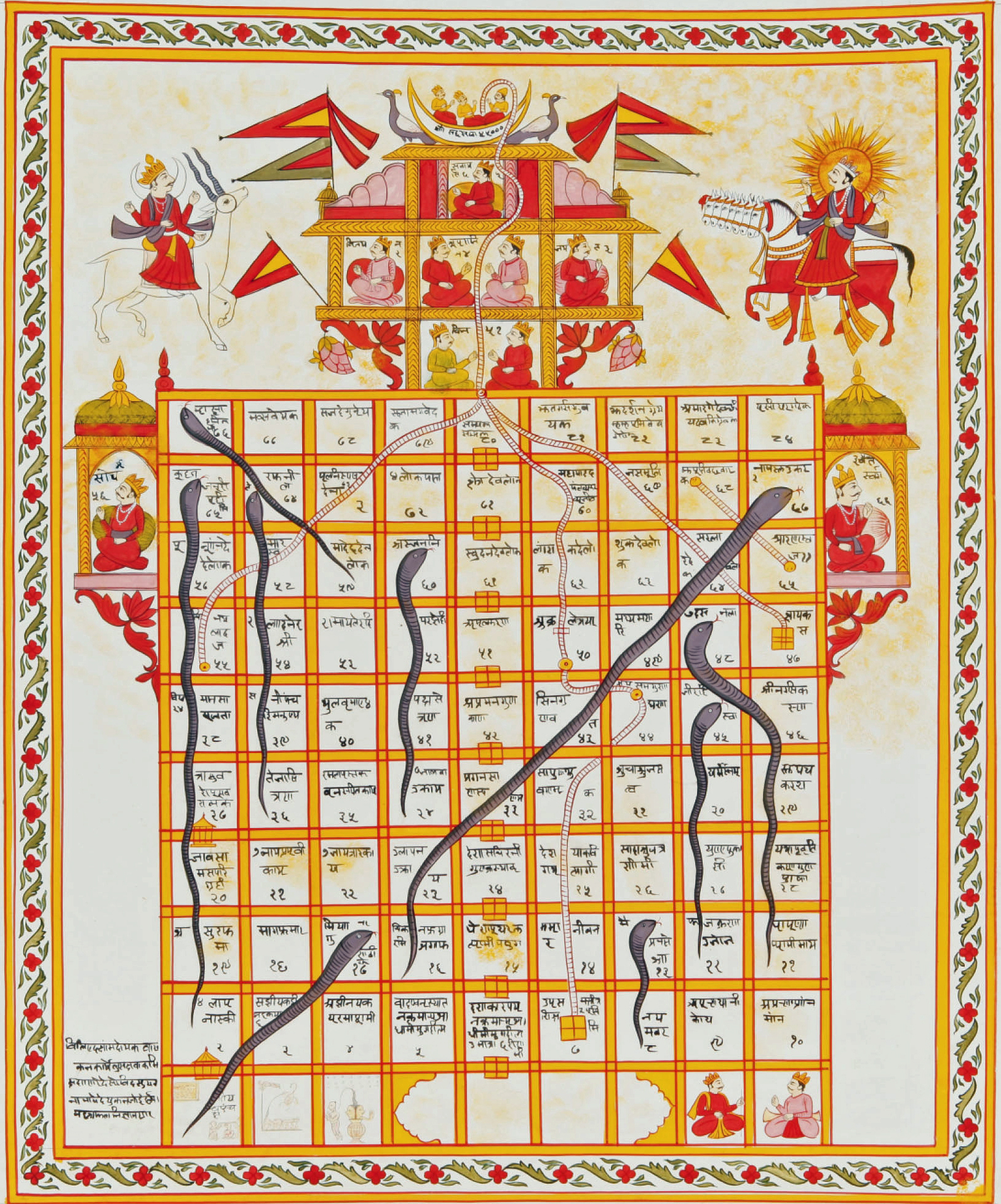
Worry not– that seems to be the overarching message of the game as its Indian inventors understood centuries ago, channeling Lord Krishna’s messages on the primacy of action and not outcomes in the Bhagavad Gita. To understand the game, step out of it, look in and look out. Always, always, remember the context in which your actions are situated — in inaction that must be consistently negated — and that which will determine the outcome — your nature and duty, and my wisdom and all-encompassing responsibility, Krishna tells Arjun.
To some this worldview is grimly mechanical and agency-reducing. To me, as I suspect it was to the inventors of Moksha Patam, the point is to keep rolling the die at each turn (dharma, the imperative of the individual), the outcome — either lift or descent or simply trudging along — the result of a trillion different factors which bundled together is perceived by us, in our finitude, as noise or luck.
॥ कर्मण्येवाधिकारस्ते मा फलेषु कदाचन ।
मा कर्मफलहेतुर्भुर्मा ते सङ्गोऽस्त्वाकर्मणि॥
-- Bhagavad Gita, chapter 2, verse 47
which has been translated by Juan Mascaró as:
Set thy heart upon thy work, but never on its reward. Work not for a reward; but never cease to do thy work.
Mathematically, Snakes and Ladders can be modeled as Markov Chains (more precisely, as absorbing Markov Chains). In plain English, it means where you’d land up on the board next in the game depends only on where you are now and not where you have been. This “memorylessness” is unsettling: no matter what your trajectory has been thus far — the accrued weight of your actions — your future is bereft of past and only hinges on the present.
But this is where the message of the game also becomes extremely liberating and hopeful (and why so many children, in particular, are so fond of the game). As long as you negate inaction — as long as you roll the die at your turn — your future is open-ended, a thousand past victories or defeats rendered immaterial. The game often makes you retrace your steps after a near-fatal blow only for you to discover at the very end — as you are absorbed at the 100th square — that that wasn’t so bad after all. Or you never make it, and the other guy does. That’s fine too, you did your best, you played fair.
You learn not to worry. You are here today. You do your duty: you roll the die, indifferent in peace with your self.

 Abhijnan Rej